

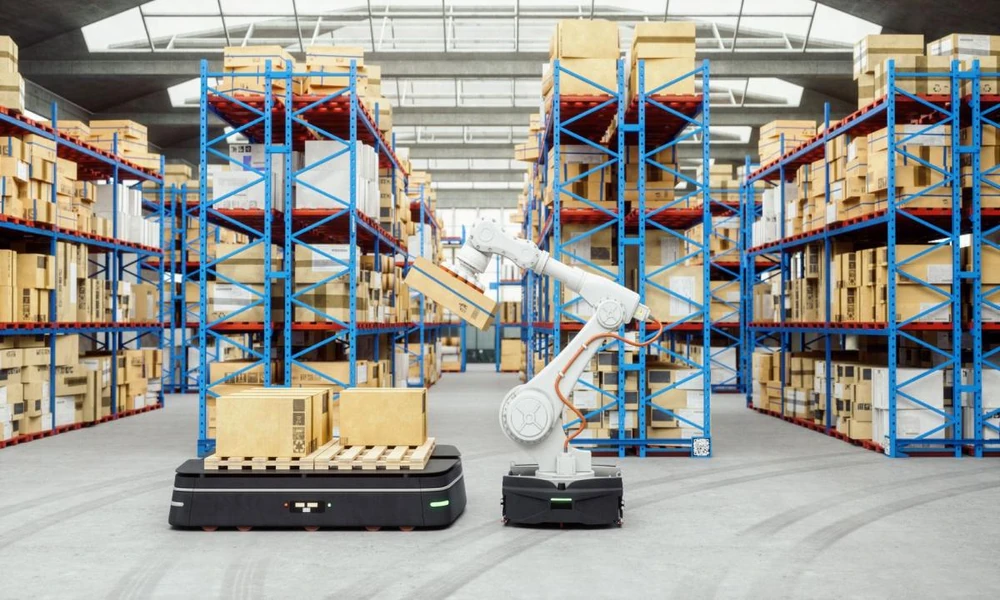

Retail technology is usually associated with ecommerce platforms, payments, analytics and customer-facing systems. Behind every digital order, however, there is still a physical process. Products have to be moved, packed, sorted and prepared for distribution, and these tasks can become a significant bottleneck as order volumes increase.
Robotics is increasingly relevant to this part of retail operations. The most useful applications are not necessarily futuristic fully automated warehouses, but focused systems that take over predictable physical tasks while employees continue to handle exceptions and decisions.
Repetition creates the clearest opportunity
Retail fulfilment contains a mixture of highly repetitive work and constant variation. Moving the same type of carton from one conveyor to another can be straightforward to automate, while picking hundreds of unrelated consumer products from mixed storage locations is much more challenging.
This distinction is important when evaluating a potential robotic cell. A task should ideally have stable inputs, a predictable movement and a clear definition of success. If workers spend much of their time solving unusual cases, the process may not be mature enough for simple automation.
Packaging and palletizing are good examples of operations where repetition often exists. Products or cartons may vary, but the underlying task remains sufficiently structured for automation to be practical.
Gripping technology has to match the product mix
Retail and ecommerce environments handle far more than rigid industrial components. Cardboard cartons, plastic packs, flexible bags and consumer products all behave differently, so the choice of gripper can determine whether a robotic project works reliably.
Vacuum can be effective for sealed cartons and many smooth surfaces, but porous or damaged packaging may reduce gripping performance. Two-finger gripping offers another option when products provide suitable contact points, while compliant systems may be useful for more delicate or irregular objects.
This is why operators assessing potential automation should check here to see how different gripping principles are applied commercially rather than assuming that one end effector can handle every package. OnRobot’s current portfolio, for example, includes electric vacuum, magnetic and finger-based solutions intended for different handling tasks.
Packaging quality becomes part of the automation process
Human workers compensate naturally for imperfect packaging. They can pick up a slightly crushed box, adjust their grip and continue working without analysing the geometry. Robots need the variation to remain within a range the system can handle.
This means that automation can expose inconsistencies that were previously absorbed by manual labour. Poor carton quality, labels placed over gripping surfaces or products arriving at unpredictable angles can all reduce reliability.
A pilot test should therefore use real production items rather than perfect samples. Testing the difficult cases early is usually more informative than demonstrating that the robot can handle the easiest package.
Labour savings are only one part of the business case
The financial argument for warehouse robotics is often presented as a comparison with labour cost, but that provides only part of the picture. Repetitive handling can also affect ergonomics, throughput consistency and the ability to manage seasonal peaks.
At the same time, robotic systems create their own costs. Equipment requires maintenance, staff need training, and some applications need fixtures or safety hardware. A realistic business case should include these factors rather than assume that every automated movement translates directly into a labour saving.
Utilisation is particularly important. A system that operates intensively for two months of the year but remains idle for the rest may be difficult to justify unless it can be redeployed.
Humans remain better at exceptions
One of the strongest models for retail automation is to separate routine work from exception handling. Robots can move predictable cartons or perform repetitive packing, while employees deal with damaged products, unusual shapes and situations that require judgement.
This division makes better use of both types of capability. Machines provide repeatability, while people remain much better at adaptation when something unexpected occurs.
For retailers, the practical goal should therefore not be maximum automation. It should be finding the parts of fulfilment where predictable physical work is consuming enough time, labour or space to justify a dedicated robotic solution.
How Robotics Is Finding a Practical Role in Retail Fulfilment
